How to Pack for a Golf Trip (And Never Think About It Again) ✈️⛳️
You know the ritual. The towel around the driver. The "which bag has my belts and socks? Did I bring a vest?" The travel bag that became a catch-all somewhere between your closet and suitcase.
The problem isn't what you're bringing. It's that none of it works together. Here's the system that fixes that — start to finish.
Before You Pack
Size your travel bag right. Your golf bag and travel bag need to work together. A small travel bag around a large golf bag leaves your clubs exposed and little room for anything else. Go large or XL — it fits a range of golf bag sizes with room for a packed Birdie Pack, shoes, and the rest of your gear. If a larger travel bag isn't an option, bring a smaller golf bag instead so your Birdie Pack still has the room it needs.
Ship or fly with your clubs? There's no wrong answer, just logistics. Shipping needs 5–7 days of lead time — tough in summer when you're playing up until you leave, and next-day shipping your clubs with your Birdie Pack is expensive and still not guaranteed. Then the receiving questions: Does the resort have someone ready to accept them? Is there someone at the Airbnb to receive them? A separate delivery dock? How does the pro shop know they arrived? If you can answer those, shipping with your Birdie Pack packed inside may be an option. If not, fly with them. Birdie Pack works either way.
Know before you fly. Golf bags fly as standard checked luggage on every major US airline, which means the same 50 lb limit as any other checked bag. Some airlines technically define golf luggage as 14 clubs, a pair of shoes, and golf balls. Nobody travels like this. Nobody. The real number to remember is 50 — and if you have status or a fare that bumps you to 70, even better. Either way, the weight strategy below keeps you under it. Check your airline's baggage page before you book; it takes two minutes.
Step 1: Pack Your Birdie Pack
- Pull the four pockets off the garment bag and pack them.
- Roll your clothes. Fewer wrinkles while maximizing your space. How you organize the pockets is up to you — some pack by outfit, some put bottoms in one pocket, shirts in another, outerwear in a third, socks and underwear in the fourth. There's no wrong system. The point is that it's your system, and you'll know exactly where everything is.

- Hang what needs hanging. Use the hangers that come with your Birdie Pack — they're built for the ladder hanger inside the garment bag, and they work. Keep the nice wooden ones for home or the club. And even if nothing needs hanging — bring the garment bag anyway. It protects your clubheads in transit and becomes your closet on the road. You never know when a pro shop shirt or two needs a place to live.

Step 2: Prep Your Golf Bag
- Pop the driver head off. Wood heads too, if you'd like. Take a photo of each hosel setting first so there's no guessing at the other end. Heads go in their headcovers; headcovers go in the side pocket or ball pocket of your golf bag. Toss the wrench in with them.


- Add a stiff arm. Simple, it works, and it's a non-negotiable. It takes the impact so your shafts don't.

- Flip a few irons head-down. This cuts down on club chatter, adds protection, and clears room at the top of your bag so the garment bag can wrap cleanly around your clubheads. Just don't flip everything — a bag full of heads at the bottom is a pain to unload.

- Drop a tracker in. AirTag or equivalent, into an internal pocket. These come in handy and will give you peace of mind.

- No matter what, some things need to and should live in your carry-on. The principle: heavy, powered, or irreplaceable goes with you.
-
- Rangefinder and anything with batteries. Lithium batteries don't belong in checked luggage — they go in the cabin. Rule, not preference.
- Golf balls. A few sleeves don't feel like much until they're the reason you're overweight.
- Your valuables pouch. The ball marker from that trip. The divot tool you can't replace. These are the things you'd actually miss. In the carry-on, every time.

- Dopp kit and liquids: seal them. Anything over the carry-on liquid limit — full-size sunscreen, spray deodorant, bug spray — goes in your golf bag, caps on, inside a sealed plastic bag. Aerosols are fine in checked luggage as long as the nozzle is protected; that's the actual rule. Travel-size versions under 3.4 oz can ride in your carry-on if you'd rather. Either way, seal them — a cracked bottle of sunscreen loose in your golf bag is a mess you'll be cleaning out for a season. Stay tuned — Birdie Pack may have a solution for this too.

Step 3: Pack Your Travel Bag
- Lay the travel bag flat, fully unzipped and open.

- Garment bag near the top, laid open; golf bag on top of it; clubheads at the top. One thing first: take the packed pockets off the garment bag before you wrap.


- Wrap the garment bag around your clubheads. A garment bag wrapped around clubheads with full pockets attached will not fit in your travel bag. Snap the buckles and don't be shy about tightening — a snug wrap kills bag chatter and makes zipping up easier. Adjust how it sits if your golf bag has a big handle or an odd top. We like the Birdie Pack logo facing up — or your club's logo if yours is custom. A small reminder for TSA: right, I remember seeing that one when I unzipped the bag.

- Packed pockets go near the bottom of the travel bag. There is more room down there; it's easiest to zip.

- Socks go inside your shoes. Ditch the heavy shoe trees. If you're worried about shape or moisture, inexpensive plastic shoe trees and reusable drying packets do the job at a fraction of the cost.

- Zip, snap, buckle. Done.

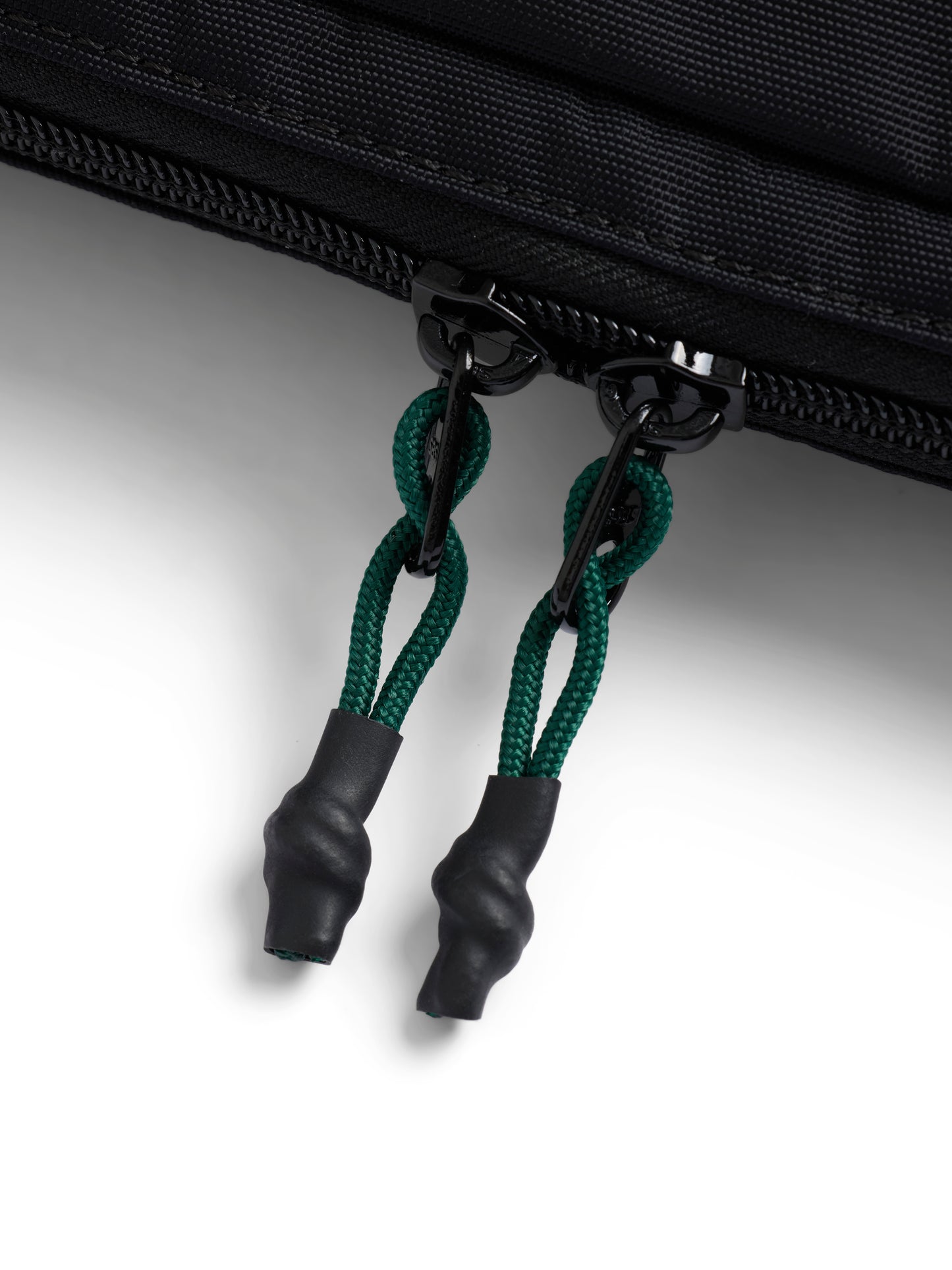
Travel hack: take the paracord from your Birdie Pack hangtag and loop it onto the top zipper of your travel bag. Easier to zip, and one more way to spot your bag at baggage claim.

At the Airport
Two bags. A carry-on and a travel bag. That's the whole caravan, and it changes how the airport feels.
The moment of truth: the scale. If you're over 50, don't stress — it's a thirty-second fix. Unzip, pull a Birdie Pack pocket or two, drop them in your carry-on, reweigh. Before Birdie Pack, you'd be kneeling on the terminal floor, redistributing loose polos and hoping. Now you're moving one organized pocket, and you know exactly what's in it.
Keep the luggage slip and toss it in your passport book or wallet. The barcode tag from check-in is how you track your bag in the airline's app — and what baggage claim may ask for at your destination. Between the app and your AirTag, you'll always know where your clubs are.

Most airlines route travel bags through an oversized luggage drop after check-in. Drop it, head to security, and enjoy boarding without the overhead-bin scramble.
Worried about a TSA inspection? Remember what they're looking at: four organized pockets and two buckles, not a loose pile of polos, shorts, and rain gear. Your travel bag has more zippers and snaps than a Birdie Pack does. It goes back together because there's a way it goes together.
You've Landed
Oversized luggage takes a little longer to come out. Don't sweat it — check the airline app or your AirTag while you wait.
Then grab your bag and go. Car service, Uber, rental car — whatever the airport makes you walk through to get there, you're doing it with two bags instead of three or four.

Unpacking (The Slick Part)
Unzip the travel bag. Pull the pockets. Lift out the golf bag, then the garment bag. Hang the garment bag, click the pockets back on. Socks from your shoes go in a pocket.

That's it. Your closet for the trip is set. Your buddy is still looking for his belt.
Reattach your wood heads with the wrench you packed — pull up the hosel photos if you need them. Rangefinder, golf balls, and valuables pouch go back in your golf bag. Stiff arm comes out and lives in the travel bag, and the travel bag gets stashed out of the way — inside. Outside seems like a great spot until wildlife, weather, or a stray campfire ember finds it.
Now go play. Everything goes back the way it came because everything has a place.
Pack it once, and every trip after that is muscle memory. ✈️⛳️